


INTRO: Sure, kids can be funny and adorable. But they can also be incredibly creepy. Imagine this: a town that’s completely overrun by children who are murderous, blade-wielding little maniacs. Children that want to sacrifice all adults to an evil god so they can have healthy corn crops. Unnerving, isn’t it? Well, that’s exactly the vision director Fritz Kiersch brought to the screen with his 1984 Stephen King adaptation Children of the Corn. It’s a film that has spawned many poorly received sequels and reboots that have tarnished its reputation. But if you’ve been avoiding it because of that, we have to let you know: Children of the Corn may be the Best Horror Movie You Never Saw.
CREATORS / CAST: Children of the Corn was marketed as being “an adult nightmare”. So maybe it’s fitting that the short story Stephen King wrote was first published in the pages of the adult magazine Penthouse. It was then included in King’s 1978 short story collection Night Shift – and it wasn’t long before studios started inquiring about the film rights to the stories in that book. Children of the Corn sold to an unexpected company: Hal Roach Studios. Best known for their comedic output, they had been called “The Laugh Factory to the World”. They had even been behind the Our Gang franchise, also known as The Little Rascals. Now apparently they were interested in making a movie that would ask the question, “What if the Little Rascals were homicidal?”
Children of the Corn follows a couple named Burt and Vicky, who are passing through Nebraska on a road trip to the West Coast. When they hit a child that comes stumbling out of a cornfield and into the road, they seek help in the nearest town. A little place called Gatlin. There they find that all of the adults have been killed off, sacrificed by the children to a monstrous god that lives in the corn. A god they call He Who Walks Behind the Rows. This god demands the blood of anyone older than their teens. And in return, the corn grows tall and healthy. Burt and Vicky, being adults themselves, are targeted by the little maniacs that have been in control of Gatlin for years at this point.
King wrote the first draft of the screenplay himself, but studio executives weren’t entirely satisfied with what he turned in. Burt and Vicky are a very unhappy couple on the verge of divorce in his story. So he dedicated the first thirty-five pages of the script to this couple bickering and having intense arguments with each other. Since that script didn’t work for them, the studio turned to a writer named George Goldsmith, whose rewrite took the screenplay further from the source material. In his version of the story, Burt and Vicky aren’t married. The tension in their relationship comes from the fact that Vicky is anxiously waiting for Burt to propose to her. Goldsmith also gave the couple some allies to interact with. In King’s story, all of the children in Gatlin are in on the deaths of the adults. In the film, there are two children who don’t agree with what the others have done. They’re not into all this He Who Walks Behind the Rows crap. And when they cross paths with Burt and Vicky, they try to help them survive the terrible situation they’ve stumbled into. King wasn’t pleased with Goldsmith’s revisions, leading to an uncomfortable phone call between the two. King claimed that Goldsmith didn’t understand horror, and Goldsmith replied that King didn’t understand cinema. His script hadn’t been cinematic enough, and the studio must have thought Goldsmith’s script was, because that’s the one they went with.
Several other companies stepped in to help Hal Roach Studios get Children of the Corn into production, including distributor New World Pictures. New World’s Donald P. Borchers became a producer on the film, and he’s the one who thought of offering the directing job to Fritz Kiersch. Even though Kiersch had never directed a feature film before. His success had come from making commercials, and Borchers was very impressed by his work. And while Kiersch would have been happy to stick with commercials, he couldn’t turn down the chance to direct a Stephen King movie. This was a huge opportunity.
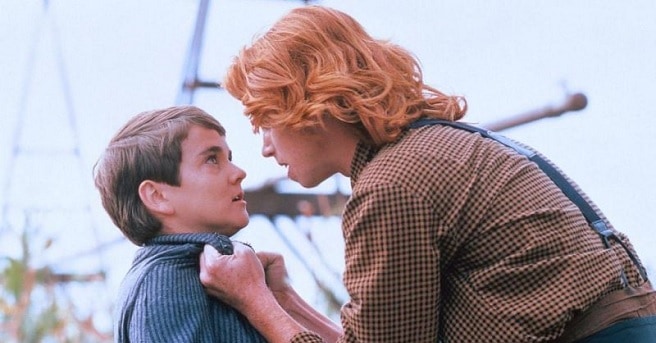
From the time he was hired, Kiersch had roughly two months to prepare before filming was expected to begin. First he went on a location scout to multiple states across the U.S. He found the cornfields and small towns he was looking for in Sioux City, Iowa and the surrounding areas. With the location chosen, and his commercial crew ready to follow him into the feature world, Kiersch began assembling the cast. The role of Burt went to Peter Horton, who was a few years away from landing a major role on the TV series Thirtysomething. For Vicky, Kiersch cast Linda Hamilton, who would go right from working on this movie to starring in The Terminator, which started filming the same month Children of the Corn reached theatres. Robby Kiger and AnneMarie McEvoy were cast as the helpful kids, Job and Sarah. Many of the He Who Walks Behind the Rows kids would be played by Iowa locals, but John Philbin was cast as one named Amos, who is ready to be sacrificed now that he’s turning eighteen. Julie Maddalena was cast as pregnant teen Rachel. Jonas Marlowe plays Joseph, an unlucky kid who gets his throat slit for trying to flee from Gatlin. Then he stumbles out into the road and gets hit by Burt and Vicky’s car. One of the few adult roles other than Burt and Vicky went to the great character actor R.G. Armstrong. He plays an old man named Diehl, who can be found at a rundown auto shop just outside of Gatlin.
The cult in Gatlin is headed up by a young preacher named Isaac. He gives the orders and his followers do the dirty work. The main enforcer of the group is Malachai, the creepiest of the bunch. He’s even more strict and dangerous than Isaac. Both of these roles went to actors who were making their film debuts. John Franklin was cast as Isaac. Even though he was in his mid-twenties, he could pass for younger because of a growth hormone deficiency. Franklin had just finished working on a commercial where he had been playing a Vulcan, and it was decided that he would keep his Vulcan haircut for Children of the Corn. They figured it would add an extra bit of strangeness to the character. Malachai was played by teenager Courtney Gains. He proved to be so effective at playing an evil little bastard, even his parents were disturbed by his performance in the movie. Gains started bringing the intensity as soon as he stepped into the audition room, where he pulled a prop knife on a casting assistant.
BACKGROUND: Kiersch and the producers didn’t take into consideration that cornfields can change a lot in a period of two months. When they returned to Iowa to start filming, they were shocked. Some of the corn wasn’t there anymore. It had been harvested. Other fields of corn had changed color; they lost their vibrant green. The crew had to scramble to find corn that was suitable to appear in the movie. One farmer was convinced not to harvest his crop so they could use it as the main cornfield in the film. Cornstalks made of polyurethane were used for some moments. And sometimes crew members had to paint the green back onto real cornstalks.
The changing cornfields weren’t the only things making this a difficult shoot. Since many of the cast members were children, the production had to take frequent breaks. The kids needed recreation and schooling. Kiersch was also working with a budget that was lower than it seemed. Technically, the budget was one-point-three million. But the director only had access to two-thirds of that amount. The rest of it went to studio executives and to Stephen King. Due to the budget being lower than expected, some scenes had to go unfilmed and Kiersch wasn’t able to include nearly as many special effects as he had envisioned. There were supposed to be more confrontations between Burt and the killer kids, but those were pared down. In the sequence where the kids attack Diehl at his auto shop, he discovers that they have killed his dog. He was originally supposed to find the dog’s severed head. But that effect would have been costly, so he finds the dog’s bloody bandana instead. Which is actually better for the movie, and still effective.
When evil is defeated in the climactic moments, Kiersch wanted to show the cornfield rotting away. They couldn’t afford that. But at least they were able to show the field burning. In King’s story, the corn god He Who Walks Behind the Rows actually shows up to attack Burt. King described this thing as a huge green creature with red eyes the size of footballs. That thing definitely couldn’t be put into the movie, so Kiersch had to find a work-around. In some shots, He Who Walks Behind the Rows is represented by a strange, colorful substance appearing in the air. This was achieved by filming ink being injected into water. That’s not very impressive, and even Kiersch refers to that effect as the cauliflower monster. The better work-around comes in shots where we see He Who Walks Behind the Rows burrowing through the ground. And this effect was simple to achieve. All they had to do was dig a ditch, put an upside down wheelbarrow in there, cover it with dirt. Then pull it through the dirt with a tractor. When He Who Walks Behind the Rows is moving underground like a Graboid, it’s just a wheelbarrow under there.
While some scenes couldn’t be shot, Children of the Corn also had – like most movies – its share of deleted scenes. The opening sequence of the film shows the children of Gatlin rising up and slaughtering the adults. But the massacre is only shown through the eyes of Job, who witnesses his father and other grown-ups being killed in a cafe. Kiersch planned to show attacks in other locations, and even filmed a sequence that focused on the town’s sheriff. That sequence didn’t turn out well for the sheriff. He’s the Blue Man, the corpse wearing a police uniform that we see crucified in the cornfield. Kiersch had to do some very careful editing in other scenes, as the Burt character was a smoker. Peter Horton wasn’t, and it wasn’t believable when he tried to act like he was. So several instances of his unconvincing smoking had to be removed.
The ratings board was cracking down on violence in horror movies around this time, but Kiersch never intended his film to be a bloodbath. He didn’t want to show blades slicing or penetrating flesh. He wanted to be more suggestive. And yet, the financial group Angeles Entertainment wanted to withdraw from the film at one point because they felt it was too gory. Thankfully, they were convinced to stay involved. And according to Kiersch’s audio commentary, they ended up taking New World Pictures to court because they didn’t receive profits they were owed.
Children of the Corn wasn’t quite on the level of the Stephen King adaptations that had come before. Several of those had been rather prestigious, and made by legends. Brian De Palma directed Carrie. Stanley Kubrick directed The Shining. George A. Romero directed Creepshow. John Carpenter directed Christine. Salem’s Lot was a TV mini-series from Tobe Hooper. David Cronenberg directed The Dead Zone. With Cujo, Lewis Teague directed Dee Wallace through a performance that King felt was Oscar worthy. And then you have this movie. A low budget flick from a first-time director who said he saw his film as a tribute to the B-movies of past decades. It wasn’t very well received by critics. But it was successful at the box office, pulling in just over fourteen-point-five million dollars.
And just because it was a tribute to B-movies doesn’t mean the filmmakers didn’t take the subject matter seriously. Goldsmith said that when he was writing the script, he saw it as a metaphor for situations in the Middle East. Speaking with Fangoria magazine, Borchers said he wanted to make this movie because “It provided the chance to make a statement that I really believed in. … The idea that an entire group of individuals at a certain location believe in a religion. Why? Because everyone else does. I was real interested in examining the idea of dogma, the idea of blind faith without questioning, and the consequences of all this.”
For his part, Stephen King wasn’t impressed with how the film turned out. When asked what he thought of it during a TV interview, he said, “I think it’s the work of people who are going to do better.” Speaking on the Netflix and Kill podcast, Kiersch revealed that he has still to this day never met King. But he was able to read a letter that King sent to the studio after he watched the movie, and he made it clear “he didn’t believe it was any good. He didn’t like the portrayal of his characters, his protagonists. Because it didn’t deal with the same messages he had written about. Adults and their problems with relationships. The stress of post-war Vietnam issues. Our film dealt a lot with dogma and following a particular voice. And should the audience believe what they hear? Should they not learn to question and challenge authority? That’s what the film’s really all about. So different points of view from the very beginning caused him to not like things.”
Maybe if King knew what was ahead, he would have gone easier on the first Children of the Corn. If he knew the movie was going to be the most sequelized and rebooted adaptation of his work. As of right now, there are eleven Children of the Corn feature films in existence, and King believes most of them have been awful. He stopped paying attention to the franchise eventually, but was always hoping there would be a Leprechaun crossover. Unfortunately, there hasn’t been. Children of the Corn does have a solid fanbase, which seems to be growing in the age of ‘80s video store nostalgia. Even the overall franchise has its fans. But negative reactions to many of the sequels appear to have tarnished the reputation of the original film as well. Since some of the follow-ups were bad, the first is sometimes written off as a bad film. But it’s worth checking out and judging on its own merits.
WHAT MAKES IT GREAT: The basic concept of Children of the Corn is already creepy as hell. The idea of a town’s children murdering their parents in cold blood, just because they’ve been brainwashed into it by a leader who is also a child. The film Kiersch made out of that idea has a very effectively unnerving atmosphere that’s enhanced by the musical score composed by Jonathan Elias. The young actors that were hired to play the cult members are also incredibly disturbing. These kids are completely convincing in their roles as brainwashed murderers… and Franklin and Gains are unforgettable as Isaac and Malachai. If handled wrong and poorly cast, the sight of a bunch of kids trying to look dangerous could be unintentionally funny. It didn’t work in some of the sequels, but Kiersch and his cast got it just right in this one.
Burt and Vicky are kind of bland characters, but at least they’re an improvement over the characters in the source material. King wrote them as very unpleasant people – and the 2009 version of Children of the Corn brought them to the screen the way he had written them. Viewers didn’t react well to that, proving that bland was better in this case. Vicky is soon reduced to little more than a damsel in distress, but it does give Burt the opportunity to become a better character. He is clearly not putting as much thought or effort in their relationship as Vicky is. He has commitment issues. But when Vicky is captured by the cult, he’s willing to take on an army of killer kids to save her.
The best characters in the movie are Job and Sarah, who aid Burt in his effort to get Vicky back and take down the cult. They bring an appreciated lightness to some scenes, and they’re good sidekicks for Burt to have. And while they’re not in the short story, Sarah does seem like a King character. She has psychic ability and shares the visions she has through crayon drawings. Definitely something you would find in a King story. As maligned as it is, this movie actually improves on the source material in multiple ways. Kiersch and Goldsmith made the characters more interesting and tolerable, while doing a great expansion of the concepts and scenes in the short story. Of course, King would disagree.
BEST SCENE(S): Children of the Corn gets started with one of the most memorable and chilling scenes to come out of ‘80s horror. Job is just hanging out with his dad in the local cafe. Enjoying a Sunday morning milkshake. Then a group of teenagers, including Malachai, pull out weapons and kill every adult in the place. Including Job’s father. While all of this is going on, Isaac is watching the action through the front window. Approving.
That opening scene may be the highlight of the whole movie, but there are more deeply troubling scenes to come. Like when Diehl realizes the kids are coming to attack him at his auto shop and have already killed his dog. One of the most often quoted scenes comes when Malachai tries to draw Burt out by walking down the street while holding Vicky captive. His cries of “Outlander!” have been echoed by fans of the movie many times over the decades. Another line that gets quoted by fans is “He wants you too, Malachai” – spoken by Isaac after his right hand man has betrayed him and offered him up to He Who Walks Behind the Rows.
At the encouragement of Linda Hamilton, Courtney Gains got quite rough with her during the “Outlander” scene. According to Gains, she was left with broken capillaries in her cheeks because he grabbed her face so hard. That wasn’t the only time things got real in a scene involving Vicky. One of the best jump scares is at the end of a sequence where Vicky is dreaming about Joseph’s corpse, which is lying on the road, covered with a blanket. She approaches the body, kneels down beside it. Then the dead, bloody kid tosses the blanket back and reaches out like he’s going to strangle her. Part of why this works so well is because not even Hamilton was expecting it to happen. She didn’t know the actor was beneath the blanket, she thought she was kneeling beside a mannequin.
PARTING SHOT: Rolling Stone magazine may have given Children of the Corn the best review it ever received. In 2019, they ranked the film at number seven on their list of the top thirty Stephen King movies, sandwiched between The Shawshank Redemption and Christine. The write-up called it “a lean, brutally tense slasher film” that features “deft weaponizing of American cultural tensions”. That’s giving the film more credit than most critics had before, and it deserves more credit.
It’s not as prestigious as the earlier King adaptations. It’s a low budget B-movie about killer kids. But it’s good, it’s creepy, and it sticks with you. Other filmmakers have tried to replicate what Kiersch and his cast and crew did with this movie, and they haven’t quite managed to reach the same level. Although some of the Children of the Corn sequels are worth checking out, too. But if it’s possible to make a better Children of the Corn movie than this one, we haven’t seen it yet.
A couple previous episodes of the Best Horror Movie You Never Saw series can be seen below. To see more, and to check out some of our other shows, head over to the JoBlo Horror Originals YouTube channel – and subscribe while you’re there!





The comment section exists to allow readers to discuss the article constructively and respectfully, focused on the topic at hand.
What’s Not Allowed